Saturday, April 20, 2013

Are pragmatic pineapples going green?


So my gas-powered lawnmower finally died. Regardless of how many times I pulled the cord, it wouldn't start. After 12 seasons of heavy use, I wasn't surprised. It had been a good lawnmower and its time was up.

As I began looking for a new one, the pragmatic side of me took hold. I decided to buy a  40-volt battery-operated Greenworks mower. But before passing judgment on me, thinking that I've gone green, think again.

I truly believe that the days of the internal combustion engine are becoming obsolete. The internal combustion engine requires a tremendous amount of maintenance: oil changes, spark plug and air filter replacement, just to name a few. And all those moving parts from pounding pistons and pinging valves.

The battery lawnmower on the other hand requires little maintenance except charging the battery and sharpening the blade. There's only one moving part, the rotor, which turns the shaft. In other words, no oil, no gas ... just pure battery. Now when I need to mow, I just push a button.

There are a few drawbacks to the battery mower and, admittedly, the technology is still in its infancy. For example, one downside is its 40-minute battery life. However, that's a simple fix. I just take out the battery and plug it into the charger. Meanwhile, I take a break and sip on a cold glass of lemonade, watch some TV, and talk with the wife. Voila! In about an hour, I put the battery back in the mower and continue on my journey.

Another drawback is lack of sturdiness. The battery lawnmower, while being lightweight, is kind of flimsy as opposed to its more mainstream counterpart. Even though it has a metal deck, everything else is kind of plastic. It's like switching from a 1966 Pontiac GTO classic muscle car to an electric Toyota Prius. Another drawback is the price. The technology is still new and expensive, but as time passes, I believe the price will go down.


So what do I think about this new lawn care contraption? The battery lawnmower had no problem plowing through six inches of grass, and I enjoy its light weight maneuverability. For now, this pragmatic pineapple is moving away from the soon-to-be-obsolete internal combustion engine. So while my neighbors may be laughing at me, I'm just saying I'm not going green. I'm going for purely simple and maintenance free electric machinery.

Twenty-first Century Transportation

Complex Problems Deserve Thoughtful Answers

Vienna
Interstate 66 and Metro in Vienna.

"There are no simple solutions...Only intelligent choices"
-- Caterpillar Advertisement from the 1960's 

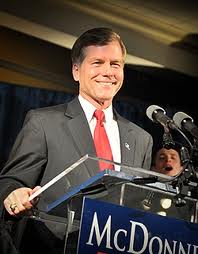
Recently the state of Virginia hammered out an agreement to deal with the transportation issues of the Twenty-first Century. While there are things to love about the agreement and things to dislike, two points should be considered. First, from the time of George Washington to the present, good infrastructure has always been seen as essential to the functioning of a robust and prosperous nation. You can see that in the attention men like Washington paid to canals, and later that which men like Declaration of Independence signer Charles Carroll of Carrollton paid to Railroads. Governor McDonnell's work on transportation builds on good precedent.

Second, and perhaps less discussed, is the idea that mobility is an essential component of liberty. Holding taxation low at all costs might decrease the ability of citizens to access employment choices and other resources necessary for their well being. People from all over the region, for example, travel to the University of Virginia Medical Center or Johns Hopkins for essential healthcare services.

One publication I especially enjoy is American Conservative. One issue they regularly address is the importance of a diverse transportation system. While some may rail about the cost of public transportation, it is important to look at the amount of money that goes into roads as well. With the mission being to provide maximum mobility at the most reasonable cost, transportation design might just get a whole lot more interesting. Good analysis must consider the total cost of a highway-only approach versus a well designed mixture.

When my Mother moved to Baltimore, she did not drive. She pursued graduate work at Johns Hopkins and a career at the Martin Company. Streetcars empowered her. A decade after she moved to Baltimore, traffic engineers removed the streetcars. Mom learned to drive. Now engineers are reconsidering the streetcar, or light rail equivalents. The end result could be greatly increased mobility (and opportunity) for urbanites. The American Conservative Center for Public Transportation [click to read] offers more insight into transportation planning for the future.

Thursday, April 18, 2013

"USA! USA! USA!"


When tragedy strikes, we are not Republicans or Democrats ... we are Americans!
After Ryan Miller and the Buffalo Sabres pulled out a comeback win over the Bruins, they had one last gesture to mark the significance of Boston’s first pro game since the marathon bombings.

Players from both teams gathered at center ice and raised their sticks in a salute to the city and fans who had shouted, “We are Boston” and “USA, USA,” during the game.
The Detroit Free Press has more.

Cross-posted at LynnRMitchell.com

Wednesday, April 17, 2013

Pragmatic leadership: Saxman, Moran, Jones form public affairs, business firm

In a press release on Wednesday, former Delegate Chris Saxman, former Democratic Party of Virginia chairman Brian Moran, and Rob Jones announced a new partnership between three names familiar in Virginia political circles.
Today we announce the launch of a new partnership between three established names in Virginia, Brian Moran, Chris Saxman and Rob Jones. This team is joining forces to create New South Strategic Partners, a public affairs and business strategy services firm. New South SP will be guided by its extensive state and local government experience, in both the legislative and executive branches.

In an era of government gridlock and heightened partisanship, New South SP will offer common-sense solutions to common problems. With the shifting political landscape in Virginia, many of the challenges facing the Commonwealth require responses that both Democrats and Republicans can support. Moran and Saxman are leaders in their respective parties who also have respect and credibility across the political aisle. The New South SP team recognizes that our elected officials need to be pragmatic and can do so without compromising their principles.
More leaders who recognize that leadership can be pragmatic without compromising core principles.

Cross-posted at LynnRMitchell.com

Tuesday, April 16, 2013

A bipartisan path to immigration reform

Immigration is an area where pragmatic leadership is definitely needed. Those on either side of the issue are passionate about their viewpoints and often unwilling to budge on their demands.

Republican Senator John McCain from Arizona and Democratic Senator Charles Schumer from New York weighed in on the immigration issue in Tuesday's Wall Street Journal. It is a complex issue that has taken years to get to the point where it will be discussed this week in Congress.

In their op-ed, the senators wrote:
This week, we join a bipartisan group of six senators to introduce comprehensive immigration-reform legislation. This is the first step in what will be a very difficult but achievable process to fix the nation's broken immigration system once and for all. The legislation's approach is balanced: It is firm in cracking down on illegal immigration but sensible when it comes to legal immigration.

Our group's effort included the active participation of some of the most conservative and liberal members of the Senate. We engaged in hundreds of hours of very tough negotiations, which nearly broke down at several points. But we forged consensus and now stand ready for an open, transparent process to move this issue forward in Congress.

Like all genuinely bipartisan efforts, this bill is a compromise. It will not please everyone, and no one got everything they wanted. The legislation we introduce on Tuesday has more support than any past effort. In a time of deep partisanship in Washington, groups that have been at loggerheads on a range of issues for years—from the AFL-CIO to the Chamber of Commerce, from the United Farm Workers to the American Farm Bureau Federation—have come together to support our bill.
It remains to be seen if there will be open minds willing to work together and compromise on what has taken hundreds of hours of meetings, discussion, and pounding out areas of concern about how to include:
These requirements include a criminal-background check; paying a fine and back taxes; learning English; and going to the back of the line to wait for the privilege of applying for American citizenship. In this way, we balance America's heritage as a nation of immigrants with the imperative of upholding the rule of law. When these formerly illegal immigrants become law-abiding members of society, it will improve their lives and the lives of their families—and it will strengthen the nation and the U.S. economy.
The column includes much more information that is a must-read for those truly interested in learning all sides of the immigration debate. Push-back has already begun with Senator Marco Rubio receiving criticism about his willingness to compromise. On Tuesday, tea party activists in Florida planned to protest outside his office, saying they were upset at the "closed-door" process that has led to the proposed immigration reform.

The senators conclude by noting, "A healthy, functioning immigration system is vital to securing the integrity of America's sovereign borders, advancing our economic growth, and protecting human dignity." Real reform will take a bipartisan effort with give-and-take from all sides.

More details of the immigration overhaul plans are at The Hill

Cross-posted at LynnRMitchell.com

Thursday, April 11, 2013

Why I am a pragmatic Pineapple


Over the last several years we have seen a shift in the political environment with a polarization between far-right conservatives and moderate Republicans. In the likeness of Virginia's Governor Bob McDonnell, Political Pineapples do not compromise their values and core beliefs. However, they are pragmatic and apply Ronald Reagan's 80 percent rule: "The person who agrees with you 80 percent of the time is a friend and an ally -- not a 20 percent traitor." This is what separates the Pineapples from the Coconuts. Coconuts are hard and rigid on the outside, so much so they require a hammer to crack. Pineapples, on the other hand, may appear prickly but are soft and sweet in the middle.


Monday, April 8, 2013

Ronald Reagan: "Belief in 'We The People' drove his pragmatism and principles"


At Sunday night's Ronald Reagan dinner held by the Charlottesville Republicans, former U.S. Transportation Secretary Jim Burnley, who served during the Reagan administration, was a keynote speaker along with Karl Rove who worked in the George W. Bush White House.

During his remarks, Secretary Burnley noted that President Reagan was a pragmatic leader, as noted on Bearing Drift:
President Reagan was often pragmatic, willing to compromise with Congress to make progress toward his goals, recognizing that it sometimes came, as he said, “in inches and feet.” But when it came to his principles, he was steadfast.
Pragmatic, principled leadership....

Virginia wins with McDonnell's pragmatic leadership


On election night in November 2009, many of us were at the jam-packed Richmond Marriott listening to the Black Eyed Peas' "Tonight's Gonna Be a Good Night" playing in the background as it was jubilantly announced that Bob McDonnell had won the gubernatorial race. The win was historic. He had won with the most votes of any governor in Virginia history by running an incredible campaign on the economy and "Bob's for Jobs" and, in the process, helped sweep in a wave of Republicans with him.

It was a victorious evening following years of GOP losses. McDonnell had brought the Republican Party of Virginia back after losing two straight gubernatorial races (2001, 2005), two straight U.S. Senate races (2006, 2008), and a presidential race (2008).

The new governor hit the ground running, fulfilling his campaign promise to immediately reopen the 19 rest areas and welcome centers that had been closed by Democrat Tim Kaine in the final six months of his administration after he claimed there was not enough money to keep them open.

McDonnell then went to work on his campaign promise of jobs. Virginia's unemployment is now down to 5.5%, the lowest in four years, the lowest in the Southeast, and the lowest east of the Mississippi. Bob's for Jobs.

All along the way, this pragmatic conservative leader pushed for what was best for Virginia. Public service has been his life. A 21-year U.S. Army veteran who retired as a Lieutenant Colonel, he served in the Virginia legislature as a delegate before becoming attorney general and then governor. 

When McDonnell took the oath as governor, he knew he was inheriting a transportation problem that had hung over previous occupants of the Executive Mansion for decades. Reminiscent of "Dave" in the movie of the same name, he and his staff figuratively took out the red pencil and went to work auditing, cutting, and abolishing unnecessary expenditures.

They tried everything from privatizing Virginia's ABC stores (voted down by the General Assembly) to auditing VDOT to using all the Commonwealth's debt capacity available to build roads. The math didn't work out. So he assembled a broad coalition of over 60 transportation, business, and labor groups to press for immediate action on the 27-year problem, reaching out to Democrats as well as Republicans.

The final plan was submitted to the 2013 General Assembly but it was kicked to committee where a compromise was hammered out. The historic landmark legislation passed in the General Assembly with a bipartisan vote of 44 Republicans and 43 Democrats.

In 2010 when McDonnell stepped into the governor's office, he inherited the largest budget deficit in the history of the Commonwealth with a $4.2 billion budget introduced by outgoing Democratic Governor Tim Kaine. No governor had ever taken office confronting a budget shortfall of that size. By reducing spending instead of tax hikes, McDonnell was able to close the historic budget shortfall and reduce state spending to 2006 levels. He ended the session with 80 percent of his legislative proposals passing the General Assembly.

In 2011, legislators passed 92 percent of the Governor's legislative proposals. One was his bipartisan "Top Jobs" higher education reform act that created the pathway for 100,000 more degrees to be awarded in the Commonwealth over the next 15 years, prompting Democratic State Senator Edd Houck to note, "Some have suggested this is the most significant and comprehensive higher education initiative since the creation of the Community College System 40 years ago." He also gained legislative approval for elimination of various boards and commissions to make state government smaller and more efficient.  CNBC named Virginia their Top State for Business and reported that the Old Dominion received the highest point total in the history of their rankings. That same year, Pollina Corporate named Virginia the "Most Pro-business State in the Nation," and noted, "Virginia is the unquestionable brightest star on the American flag when it comes to being pro-business ... Virginia is truly in a class by itself."

In 2012, the Governor saw 88 percent of his agenda passed by the General Assembly. Unemployment was at 5.6 percent which was 23% lower than when he took office two years earlier. Agricultural exports reached an all-time high, and cattle were to be exported to Canada for the first time in Virginia history. Soybeans were shipped to China, Green Mountain Coffee Roasters announced 800 jobs in Isle of Wight, Amazon.com brought over 1,300 new jobs, and the Chesapeake Bay blue crab population soared back to a 20-year high. Good year.

The 2013 session just concluded and the Governor saw 88 percent of his legislation passed by the General Assembly including the landmark transportation bill that will fund roads, infrastructure, and other projects throughout the Commonwealth.

Three years after taking office, Bob McDonnell's leadership has produced a string of accomplishments that will positively benefit the Commonwealth into the future.

Cross-posted at Bearing Drift and SWAC Girl

Sunday, April 7, 2013

Welcome

Throughout Virginia's history the pineapple has served as a symbol of hospitality and warm welcome.

Over the last several years we have seen a shift in the political environment with a polarization between far-right conservatives and moderate Republicans. In the likeness of Virginia's Governor Bob McDonnell and Lieutenant Governor Bill Bolling, along with Presidents Ronald Reagan and George W. Bush, Political Pineapples do not compromise their values and core beliefs. However, they are pragmatic and apply Ronald Reagan's 80 percent rule: "The person who agrees with you 80 percent of the time is a friend and an ally -- not a 20 percent traitor."

Being politically pragmatic, we will strive to move Virginia forward. We invite you to join us as we engage in polite and courteous political discourse while promoting tolerance, open dialogue, and bipartisanship for the good of the Commonwealth.


Contributors

 Kurt Michael


Kurt lives in Augusta County, Virginia. He is active in his church and the community, and has been involved in Virginia politics for more than 20 years. He is a former chairman of the Augusta County Republican Committee.

You can email him at kmichael1@juno.com

Lynn Mitchell


Lynn and her husband live in Augusta County, Virginia, and have two grown children. As SWACgirl.com (an acronym for Staunton, Waynesboro, and Augusta County), she has been writing in the Virginia political blogosphere since 2006, currently contributing to Bearing Drift, and has done freelance work for the Washington Examiner and VirginiaVirtucon.com. One of her passions is to photograph this scenic area of the Shenandoah Valley as well as political events. Lynn has served on official boards in the area and is currently a trustee with the Frontier Culture Museum of Virginia and the Augusta County Library Board. She served for eight years as a member of the State Central Committee of the Virginia Republican Party, and has been a local coordinator and volunteer for many political campaigns.

You can email her at swac.girl@gmail.com or follow her on Twitter @swacgirl.


 Bob Kirchman


Bob and his wife live in Augusta County, Virginia. They have two grown children and one grandchild. He is an artist, photographer, amateur historian, and citizen commentator on a variety of subjects. His blog, The Journey, often takes 'the road less traveled' to find interesting stories and a fresh perspective on the stories around us.

You can email him at bobsjourneyblog@gmail.com


Guest Post
The views expressed by our Guests do not necessarily represent the views of the politicalpineapple.com.